Deck & Dock Cleaning on Hilton Head Island — Clearing Algae and Slick Growth From Marshfront Wood
Controlled low-pressure washing that clears algae and slick growth off marshfront docks and wood decks — restoring grip and prepping for sealing.
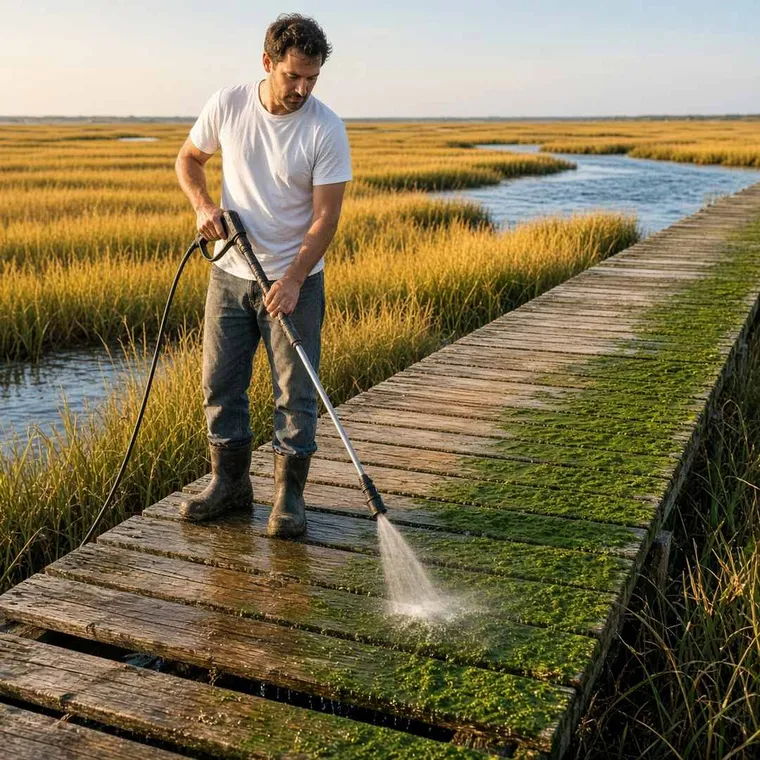
Deck and dock cleaning on Hilton Head Island clears the algae and slick green growth that build up on wood decks and the tidal docks lining the island's salt marsh and creeks. Dock boards sit in constant humidity and tidal spray, which grows a slippery film at and below the tide line, and a controlled low-pressure wash removes it without gouging the wood. The same wash preps a deck or dock for sealing or staining.
What Deck and Dock Cleaning Covers
Deck and dock cleaning on the island covers wood and composite decks, marshfront and creekfront docks, dock ramps and gangways, and the railings and steps that come with them. On Hilton Head, docks on the tidal creeks around Broad Creek, Skull Creek and the island's marsh edges collect the heaviest growth, and backyard decks under the oak canopy grow algae in the shade. A full cleaning clears the growth, brightens the wood, and leaves the surface ready for the next step.
The method is matched to the age and condition of the wood. Older, softer dock boards take a gentler touch than newer composite.
How Deck and Dock Cleaning Works
Deck and dock cleaning works by matching pressure to the wood. First, the surface is cleared of leaves, debris and loose growth. Second, a cleaning solution is applied to kill the algae and mildew in the grain where a rinse alone cannot reach. Third, the wood is washed at a controlled low pressure that lifts the growth without furring or gouging the boards. Finally, the surface is left to dry, ready for sealing or staining if that is the next step.
Controlling the pressure is the whole job on wood. Too much pressure raises the grain and damages soft dock boards, so the work relies on the solution and a careful, even wash rather than force.
Why Hilton Head Docks and Decks Grow Algae
Hilton Head docks and decks grow algae because of the marsh, the tides and the shade. Docks on the tidal creeks around Broad Creek and the island's salt marsh sit in constant moisture and tidal spray, which grows a slick film at the waterline that makes the boards dangerous underfoot. Backyard decks in shaded neighborhoods like Sea Pines and Wexford grow algae and mildew in the oak canopy's damp shade.
The slick growth is a real hazard on a dock where people walk to a boat or a kayak, and on an island where marshfront living is the draw, a clean, safe dock matters. Clearing the growth restores grip and protects the wood from the moisture the algae traps against it.
Work is performed by independent professionals.
What to Look for in a Deck & Dock Cleaning Pro on Hilton Head
A safe deck or dock cleaning on the island includes the following.
- Controlled low pressure matched to the wood, never high pressure that furs or gouges soft dock boards.
- A cleaning solution to kill algae and mildew in the grain, not just a surface rinse.
- Attention to railings, steps and gangways, not only the deck surface.
- Readiness for sealing or staining if that is the plan, with the wood cleaned and dried properly.
- Liability insurance verified before work over the water.
Insurance and a wood-appropriate low-pressure method are what to confirm, since South Carolina has no license specific to this work.
Areas Served
Deck and dock cleaning covers marshfront and creekfront homes across Hilton Head — the Broad Creek and Skull Creek docks, Sea Pines and Wexford on the south end, and Hilton Head Plantation and Spanish Wells on the north end — plus Bluffton, Palmetto Bluff and Daufuskie Island.
Frequently Asked Questions
Can a wood dock be pressure washed safely on Hilton Head?
A wood dock should be cleaned with controlled low pressure, not high pressure. High pressure raises the grain, furs the surface, and gouges the soft, weathered boards common on older Hilton Head docks. A proper dock cleaning uses a cleaning solution plus a careful low-pressure wash that lifts the slick algae without damaging the wood, which is what keeps the boards sound.
Why are my dock boards so slippery?
Dock boards on Hilton Head grow a slick algae film because they sit in constant moisture and tidal spray along the island's creeks and salt marsh. The film builds at and below the tide line where the boards stay wettest, and it makes the dock dangerous underfoot. A cleaning with solution and low pressure kills and lifts the algae, restoring grip to the boards.
Does deck cleaning prepare the wood for staining?
Yes. A proper deck or dock cleaning on Hilton Head clears the algae, mildew and gray weathering from the wood and, once the surface dries, leaves it ready for sealing or staining. Removing the growth and grime first is what lets a stain or sealer bond to the wood, so cleaning is the standard first step before refinishing a marshfront deck or dock.
How often should a marshfront dock be cleaned?
Marshfront docks on Hilton Head benefit from cleaning at least once a year because the constant tidal moisture grows algae quickly. Docks on the shadier creeks or under tree cover may need it more often to stay safe underfoot. The slick growth returns in the island's humidity, so a regular cleaning keeps the boards from becoming a hazard where people walk to a boat.
Can you clean composite decking too?
Yes. Composite decking on Hilton Head is cleaned with a low-pressure wash and a solution that lifts the mildew and algae that grow on its surface in the island's humidity. Composite does not need refinishing like wood, but it still collects organic growth in the shade, and a gentle cleaning clears it without damaging the board surface or its finish.
Call Now for Deck & Dock Cleaning on Hilton Head Island
Reach a local exterior-cleaning pro who matches the method to the surface across Hilton Head and the Lowcountry.